

Mostrar el registro sencillo del ítem
Ciudades inteligentes y movilidad en bicicleta como factor de sostenibilidad. Un análisis en ciudades intermedias en Colombia.
| dc.contributor.author | Torres Mendivelso, Javier | |
| dc.contributor.author | Castro Silva, Hugo Fernando | |
| dc.contributor.author | Velásquez Pérez, Torcoroma | |
| dc.coverage.spatial | Colombia | en_US |
| dc.date.accessioned | 2025-10-16T13:04:54Z | |
| dc.date.available | 2025-10-16T13:04:54Z | |
| dc.date.issued | 2020-08-14 | |
| dc.identifier.issn | 1692-7257 | en_US |
| dc.identifier.uri | https://repositorioinstitucional.ufpso.edu.co/xmlui/handle/20.500.14167/5770 | |
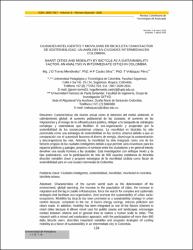
| dc.description.abstract | Características del mundo actual como el deterioro del medio ambiente, el calentamiento global, el aumento poblacional de las ciudades, el aumento de las migraciones y el rezago de la infraestructura pública, obligan a la búsqueda de estrategias complejas y sistemáticas que faciliten el eco-organización y propendan por la sostenibilidad de los socioecosistemas urbanos. La movilidad en bicicleta ha sido promovida como una estrategia de sostenibilidad en los centros urbanos debido a que en comparación con el automóvil favorece el ahorro de energía, disminuye la contaminación y descongestiona las vías. Además, la movilidad ha sido integrada como uno de los factores propios de las ciudades inteligentes debido a que permite usos novedosos para los espacios públicos y paisajes, propicia el contacto entre los ciudadanos y en general intenta devolver una escala humana a las ciudades. Esta investigación con enfoque mixto y de tipo exploratorio, con la participación de más de 500 usuarios cotidianos de bicicleta describe variables clave y propone estrategias de la movilidad ciclista como factor de sostenibilidad para en una ciudad intermedia de Colombia. | en_US |
| dc.language.iso | spa | en_US |
| dc.relation | https://ojs.unipamplona.edu.co/index.php/rcta/article/view/879 | en_US |
| dc.title | Ciudades inteligentes y movilidad en bicicleta como factor de sostenibilidad. Un análisis en ciudades intermedias en Colombia. | en_US |
| dc.title.translated | Smart cities and bicycle mobility as a factor in sustainability. An analysis of medium-sized cities in Colombia. | en_US |
| dc.contributor.cvlac | Hugo Fernando Castro Silva [0001388686] | en_US |
| dc.contributor.cvlac | Torcoroma Velásquez Pérez [0000304891] | en_US |
| dc.contributor.googlescholar | Hugo Fernando Castro Silva [vxtjgAoAAAAJ] | en_US |
| dc.contributor.googlescholar | Torcoroma Velásquez Pérez [DTtZtu4AAAAJ] | en_US |
| dc.contributor.orcid | Javier Torres Mendivelso [0000-0001-7463-7184] | en_US |
| dc.contributor.orcid | Hugo Fernando Castro Silva [0000-0001-6020-402X] | en_US |
| dc.contributor.orcid | Torcoroma Velásquez Pérez [0000-0002-2968-2338] | en_US |
| dc.contributor.researchgate | Hugo Fernando Castro Silva [Hugo-Castro-Silva] | en_US |
| dc.contributor.researchgate | Torcoroma Velásquez Pérez [Torcoroma-Perez] | en_US |
| dc.contributor.scopus | Hugo Fernando Castro Silva [57205121211] | en_US |
| dc.contributor.scopus | Torcoroma Velásquez Pérez [57205116150] | en_US |
| dc.description.abstractenglish | Characteristics of the current world such as the deterioration of the environment, global warming, the increase in the population of cities, the increase in migration and the lag in public infrastructure, force the search for complex and systematic strategies that facilitate eco-organization. And promote the sustainability of urban socio- ecosystems. Mobility by bicycle has been promoted as a sustainability strategy in urban centers because, compared to the car, it favors energy savings, reduces pollution and clears roads. In addition, mobility has been integrated as one of the factors inherent to smart cities because it allows novel uses for public spaces and landscapes, encourages contact between citizens and in general tries to restore a human scale to cities. This research with a mixed and exploratory approach, with the participation of more than 600 daily bicycle users, describes important variables and proposes strategies of cycling mobility as a factor of sustainability in an intermediate city in Colombia. | en_US |
| dc.subject.proposal | Ciudades inteligentes | en_US |
| dc.subject.proposal | sostenibilidad | en_US |
| dc.subject.proposal | movilidad | en_US |
| dc.subject.proposal | movilidad en bicicleta | en_US |
| dc.subject.proposal | bicicleta urbana | en_US |
| dc.subject.keywords | Smart cities | en_US |
| dc.subject.keywords | sustainability | en_US |
| dc.subject.keywords | mobility | en_US |
| dc.subject.keywords | mobility by bicycle | en_US |
| dc.subject.keywords | urban bicycle | en_US |
| dc.publisher.faculty | Facultad ingenierías | en_US |
| dc.type.redcol | http://purl.org/redcol/resource_type/ART | en_US |
| dc.relation.references | Aldred, R., Elliott, B., Woodcock, J., & Goodman, A. (2017). Cycling provision separated from motor traffic: a systematic review exploring whether stated preferences vary by gender and age. Transport Reviews, 37(1), 29–55. https://doi.org/10.1080/01441647.2016.1200156 | en_US |
| dc.relation.references | Behrendt, F. (2016). Why cycling matters for Smart Cities. Internetof Bicycles for Intelligent Transport. Journal of Transport Geography, 56, 157–164. https://doi.org/10.1016/j.jtrangeo.2016.08.018 | en_US |
| dc.relation.references | Benedini, D. J., Lavieri, P. S., & Strambi, O. (2019). Understanding the use of private and shared bicycles in large emerging cities: The case of Sao Paulo, Brazil. Case Studies on Transport Policy, 8(September 2019), 564–575. https://doi.org/10.1016/j.cstp.2019.11.009 | en_US |
| dc.relation.references | Castro Silva, H. F. (2017). Metodología de gestión de proyectos con enfoque de agentes intervinientes. integración del ciclo en cooperación internacional. In UNIVERSIDAD EAN FACULTAD(Vol. 01). | en_US |
| dc.relation.references | Chourabi, H., Nam, T., Walker, S., Gil-Garcia, J. R., Mellouli, S., Nahon, K., Pardo, T. A., & Scholl, H. J. (2012). Understanding smart cities: An integrative framework. Proceedings of the Annual Hawaii International Conference on System Sciences, 2289–2297. https://doi.org/10.1109/HICSS.2012.615 | en_US |
| dc.relation.references | Comisión Europea. (2002). En bici: hacia ciudades sin malos humos. https://ec.europa.eu/environment/archives/cycling/cycling_es.pdf | en_US |
| dc.relation.references | Comisión Europea. (2019). La bicicleta: un aliado para el medio ambiente y para ti | España. La Bicicleta: Un Aliado Para El Medio Ambiente y Para Ti. https://ec.europa.eu/spain/news/20190603_ The-bike-an-ally-for-the-environment-and-for-you_es | en_US |
| dc.relation.references | DANE. (2018). Resultados Censo Nacional de Población y Vivienda 2018 Sogamoso, Tunja, Boyacá. https://www.dane.gov.co/files/censo2018/informacion-tecnica/presentaciones-territorio/190727-CNPV-presentacion-Boyaca-Sogamo.pdf | en_US |
| dc.relation.references | Edwards, L. (2016). Privacy, Security andData Protection in Smart Cities: A Critical EU Law Perspective. SSRN Electronic Journal. https://doi.org/10.2139/ssrn.2711290 | en_US |
| dc.relation.references | Fernandez-Anez, V., Fernández-Güell, J. M., & Giffinger, R. (2018). Smart City implementation and discourses: An integrated conceptual model. The case of Vienna. Cities, 78, 4–16. https://doi.org/10.1016/j.cities.2017.12.004 | en_US |
| dc.relation.references | Fishman, E. (2016). Cycling as transport. In Transport Reviews(Vol. 36, Issue 1, pp. 1–8). Routledge. https://doi.org/10.1080/01441647.2015.1114271 | en_US |
| dc.relation.references | Fishman, E., Washington, S., & Haworth, N. (2013). Bike Share: A Synthesis of the Literature. In Transport Reviews(Vol. 33, Issue 2, pp. 148–165). Routledge . https://doi.org/10.1080/01441647.2013.775612 | en_US |
| dc.relation.references | Fu, L., & Farber, S. (2017). Bicycling frequency: A study of preferences and travel behavior in Salt Lake City, Utah. Transportation Research Part A: Policy and Practice, 101, 30–50. https://doi.org/10.1016/j.tra.2017.05.004 | en_US |
| dc.relation.references | Giffinger, R., Fertner, C., Kramar, H., Meijers, E., Rudolf Giffinger, M., Christian Fertner, D.-I., & Hans Kramar are, D.-I. (n.d.). City-ranking of European Medium-Sized Cities. | en_US |
| dc.relation.references | Giffinger, R., Fertner, C., Kramar, H., Meijers, E., Rudolf Giffinger, M., Christian Fertner, D.-I., & Hans Kramar are, D.-I. (2007). City-ranking of European Medium-Sized Cities. | en_US |
| dc.relation.references | Gil-Garcia, J. R., Pardo, T. A., & Nam, T. (2015). What makes a city smart? Identifying core components and proposing an integrative and comprehensive conceptualization. Information Polity, 20(1), 61–87. https://doi.org/10.3233/IP-150354 | en_US |
| dc.relation.references | Goodwin, P., & van Dender, K. (2013). “Peak Car” -Themes and Issues. Transport Reviews, 33(3), 243–254. https://doi.org/10.1080/01441647.2013.804133 | en_US |
| dc.relation.references | Harrison, C., Eckman, B., Hamilton, R., Hartswick, P., Kalagnanam, J., Paraszczak, J., & Williams, P. (2010). Foundations for Smarter Cities. IBM Journal of Research and Development, 54(4). https://doi.org/10.1147/JRD.2010.2048257 | en_US |
| dc.relation.references | Heinen, E., & Handy, S. (2012). Similarities in Attitudes and Norms and the Effect on Bicycle Commuting: Evidence from the Bicycle CitiesDavis and DelftNo Title. International Journal of Sustainable Transportation, 6(5), 257–281. https://doi.org/https://doi.org/10.1080/15568318.2011.593695 | en_US |
| dc.relation.references | Kilian-Yasin, K., Wöhr, M., Tangour, C., & Fournier, G. (2016). Social Acceptance of Alternative Mobility Systems in Tunis. Transportation Research Procedia, 19(June), 135–146. https://doi.org/10.1016/j.trpro.2016.12.074 | en_US |
| dc.relation.references | Koglin, T., & Rye, T. (2014). The marginalisation of bicycling in Modernist urban transport planning. Journal of Transport and Health, 1(4), 214–222. https://doi.org/10.1016/j.jth.2014.09.006 | en_US |
| dc.relation.references | Kourtit, K., & Nijkamp, P. (2012). Smart cities in the innovation age. In Innovation (Vol. 25, Issue 2, pp. 93–95). Taylor & Francis Group . https://doi.org/10.1080/13511610.2012.6603 31 | en_US |
| dc.relation.references | Lombardi, P., Giordano, S., Farouh, H., & Yousef, W. (2012). Modelling the smart city performance. In Innovation (Vol. 25, Issue 2, pp. 137–149). Taylor & Francis Group . https://doi.org/10.1080/13511610.2012.6603 25 | en_US |
| dc.relation.references | Morales Carballo, L. (2011). La movilidad ciclista como factor de sostenibilidad: breve análisis de su emergencia en la ciudad de Sevilla. Habitat y Sociedad, 2, 109–130. | en_US |
| dc.relation.references | Naciones_Unidas. (2020). Objetivos del desarrollo sostenibles.https://www.un.org/sustainabledevelopment/ es/ | en_US |
| dc.relation.references | Pangbourne, K., & Alvanides, S. (2014). Towards intelligent transport geography. In Journal of Transport Geography (Vol. 34, pp. 231– 232). https://doi.org/10.1016/j.jtrangeo.2013.10.00 5 | en_US |
| dc.relation.references | Pucher, J., & Buehler, R. (2017). Cycling towards a more sustainable transport future. Transport Reviews, 37(6), 689–694. https://doi.org/10.1080/01441647.2017.1340 234 | en_US |
| dc.relation.references | Quijano B., L., Díez Silva, H. M., Montes Guerra, M. I., & Castro Silva, H. F. (2014). Implementación de procesos sostenibles vinculando industrias regionales: reciclaje de residuos siderúrgicos como proyecto de cambio de la manpostería en Boyacá- Colombia. Revista EAN, 77, 82. https://doi.org/10.21158/01208160.n77.2014. 817 | en_US |
| dc.relation.references | Spiegel, M. ., & Stephens, L. . (2009). Estadistica. Serie Schaum. In M. Hill (Ed.), Estadistica (3rd ed.). | en_US |
| dc.relation.references | Vandercruysse, L., Buts, C., & Dooms, M. (2020). A typology of Smart City services: The case of Data Protection Impact Assessment. Cities, 104(May). https://doi.org/10.1016/j.cities.2020.102731 | en_US |
| dc.relation.references | Washburn, D., Sindhu, U., Balaouras, S., Dines, R. A., Hayes, N. M., & Nelson, L. E. (2010). Helping CIOs Understand “Smart City” Initiatives. Helping CIOs Understand “Smart City” Initiatives: Defining the Smart City, Its Drivers, and the Role of the CIO. . https://www.forrester.com/report/Helping+CI Os+Understand+Smart+City+Initiatives/-/E- RES55590# | en_US |
| dc.identifier.DOI | https://doi.org/10.24054/rcta.v3iEspecial.879 | en_US |
Ficheros en el ítem
Este ítem aparece en la(s) siguiente(s) colección(ones)
-
Artículos [132]

