

Mostrar el registro sencillo del ítem
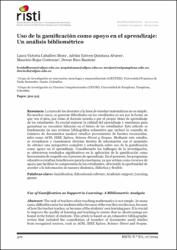
Uso de gamificación como apoyo en el aprendizaje: Un análisis bibliométrico
| dc.contributor.author | Caballero Mora, Laura Victoria | |
| dc.contributor.author | Quintana Alvarez, Adrián Estiven | |
| dc.contributor.author | Rojas Contreras, Mauricio | |
| dc.contributor.author | Rico Bautista, Dewar | |
| dc.coverage.spatial | Colombia | en_US |
| dc.date.accessioned | 2025-09-25T20:21:08Z | |
| dc.date.available | 2025-09-25T20:21:08Z | |
| dc.date.issued | 2024-07-01 | |
| dc.identifier.issn | 1646-9895 | en_US |
| dc.identifier.uri | https://repositorioinstitucional.ufpso.edu.co/xmlui/handle/20.500.14167/5615 | |
| dc.description.abstract | La tarea de los docentes a la hora de enseñar matemáticas no es simple. En muchos casos, se generan dificultades en los estudiantes ya sea por la forma en que ven el área, por cómo el docente enseña o por el propio ritmo de aprendizaje de los estudiantes. Es crucial mejorar la calidad del aprendizaje y enseñanza para garantizar no encontrar falencias en el futuro de los estudiantes. Este artículo se fundamenta en una revisión bibliográfica exhaustiva que incluyó la consulta de (número de documentos usados) estudios provenientes de fuentes reconocidas, tales como ACM, IEEE Xplore, Science Direct y Scopus. Mediante este estudio, se recopilaron y examinaron diversas fuentes de información con el propósito de obtener una perspectiva completa y actualizada sobre uso de la gamificación como apoyo en el aprendizaje. Considerando los hallazgos de la investigación, se obtuvieron resultados significativos en la aplicación de la gamificación como herramienta de respaldo en el proceso de aprendizaje. En el presente, los programas educativos resultan beneficiosos para la enseñanza, ya que actúan como recursos de apoyo que facilitan la comprensión de los estudiantes, ofreciendo la oportunidad de acceder a la información de manera dinámica, didáctica y flexible. | en_US |
| dc.language.iso | spa | en_US |
| dc.relation | https://www.proquest.com/openview/427cfb47280ed6994eceb4c33b651af1/1?pq-origsite=gscholar&cbl=1006393 | en_US |
| dc.title | Uso de gamificación como apoyo en el aprendizaje: Un análisis bibliométrico | en_US |
| dc.title.translated | Use of gamification as a learning aid: A bibliometric analysis | en_US |
| dc.contributor.cvlac | Mauricio Rojas Contreras [0000293750] | en_US |
| dc.contributor.cvlac | Dewar Rico Bautista [0000255815] | en_US |
| dc.contributor.googlescholar | Mauricio Rojas Contreras [2hxncxMAAAAJ] | en_US |
| dc.contributor.googlescholar | Dewar Rico Bautista [q_ZtKjsAAAAJ] | en_US |
| dc.contributor.orcid | Laura Victoria Caballero Mora [0009-0008-5648-7272] | en_US |
| dc.contributor.orcid | Adrián Estiven Quintana Alvarez [0009-0002-0443-567X] | en_US |
| dc.contributor.orcid | Mauricio Rojas Contreras [0000-0002-9055-5792] | en_US |
| dc.contributor.orcid | Dewar Rico Bautista [0000-0002-1808-3874] | en_US |
| dc.contributor.researchgate | Laura Victoria Caballero Mora [Laura-Caballero-Mora] | en_US |
| dc.contributor.researchgate | Adrián Estiven Quintana Alvarez [Adrian-Estiven-Quintana-Alvarez] | en_US |
| dc.contributor.researchgate | Mauricio Rojas Contreras [Mauricio-Rojas-Contreras] | en_US |
| dc.contributor.researchgate | Dewar Rico Bautista [Dewar-Rico-Bautista] | en_US |
| dc.contributor.scopus | Mauricio Rojas Contreras [57204843288] | en_US |
| dc.contributor.scopus | Dewar Rico Bautista [58689228900] | en_US |
| dc.description.abstractenglish | The task of teachers when teaching mathematics is not simple. In many cases, difficulties arise for students either because of the way they view the subject, how the teacher teaches, or the students' own learning pace. It is crucial to improve the quality of learning and teaching to ensure that students do not encounter shortcomings in the future. This article is based on an exhaustive literature review that included the consultation of (number of documents used) studies from recognized sources, such as ACM, IEEE Xplore, Science Direct, and Scopus. Through this study, various sources of information were compiled and examined in order to obtain a comprehensive and up-to-date perspective on the use of gamification as a learning aid. Considering the findings of the research, significant results were obtained in the application of gamification as a support tool in the learning process. Currently, educational programs are beneficial for teaching, as they act as support resources that facilitate student understanding, offering the opportunity to access information in a dynamic, didactic, and flexible way. | en_US |
| dc.subject.proposal | Gamificación | en_US |
| dc.subject.proposal | Software educativo | en_US |
| dc.subject.proposal | Apoyo académico | en_US |
| dc.subject.proposal | Juegos de aprendizaje | en_US |
| dc.subject.proposal | Juegos. | en_US |
| dc.subject.keywords | Gamification | en_US |
| dc.subject.keywords | Educational software | en_US |
| dc.subject.keywords | Academic support | en_US |
| dc.subject.keywords | Learning games. | en_US |
| dc.publisher.faculty | Facultad ingenierías | en_US |
| dc.type.redcol | http://purl.org/redcol/resource_type/ARTDIV | en_US |
| dc.relation.references | Alcívar, N. S., Quijije, L. S., & Gallegos, D. C. (2019). Adoption of children's educational video games monitored with dashboards in the cloud. RISTI - Revista Iberica de Sistemas e Tecnologias de Informacao, 2019(19), 146–160 | en_US |
| dc.relation.references | Arruda, H., Silva, E. R., Lessa, M., Proença, D., & Bartholo, R. (2022). VOSviewer and Bibliometrix. In Journal of the Medical Library Association : JMLA (Vol. 110, Issue 3, pp. 392–395). NLM (Medline). https://doi.org/10.5195/jmla.2022.1434 | en_US |
| dc.relation.references | Asbell-Clarke, J., Rowe, E., Almeda, V., Edwards, T., Bardar, E., Gasca, S., Baker, R. S., & Scruggs, R. (2021). The development of students' computational thinking practices in elementary- and middle-school classes using the learning game, Zoombinis. Computers in Human Behavior, 115. https://doi.org/10.1016/j.chb.2020.106587 | en_US |
| dc.relation.references | Beserra, V., Nussbaum, M., & Oteo, M. (2019). On-Task and Off-Task Behavior in the Classroom: A Study on Mathematics Learning With Educational Video Games. Journal of Educational Computing Research, 56(8), 1361–1383. https://doi.org/10.1177/0735633117744346 | en_US |
| dc.relation.references | Bontchev, B., Vassileva, D., Aleksieva-Petrova, A., & Petrov, M. (2018). Playing styles based on experiential learning theory. Computers in Human Behavior, 85, 319–328. https://doi.org/10.1016/j.chb.2018.04.009 | en_US |
| dc.relation.references | Bresnihan, N., Bray, A., Fisher, L., Strong, G., Millwood, R., & Tangney, B. (2021). Parental Involvement in Computer Science Education and Computing Attitudes and Behaviours in the Home: Model and Scale Development. ACM Transactions on Computing Education, 21(3), 1–24. https://doi.org/10.1145/3440890 | en_US |
| dc.relation.references | Brezovszky, B., McMullen, J., Veermans, K., Hannula-Sormunen, M. M., Rodríguez- Aflecht, G., Pongsakdi, N., Laakkonen, E., & Lehtinen, E. (2019). Effects of a mathematics game-based learning environment on primary school students' adaptive number knowledge. Computers and Education, 128, 63–74. https://doi.org/10.1016/j.compedu.2018.09.011 | en_US |
| dc.relation.references | Chávez-Guarniz, M. P., Rojas-Turkowsky, C. A., Bravo-Huivin, E. K., & Cieza-Mostacero, S. E. (2022). Systematic Review: Influence of educational video games in the learning process. RISTI - Revista Iberica de Sistemas e Tecnologias de Informacao, 2022(E54), 367–377. | en_US |
| dc.relation.references | Daniela, A., & Quintero, J. (2017). Desarrollo del Software educativo “calculadora inteligente” para fortalecer el aprendizaje de matemáticas básicas de los estudiantes de 1° en la Institución Educativa Alfonso López Pumarejo, Río de Oro- Cesar. Facultad ingenierías. | en_US |
| dc.relation.references | Deng, M., Ma, J., Lv, X., & Ren, X. (2023). Academic performance and parenting styles differentially predict critical thinking skills and dispositions among primary students: Cross-sectional and cross-lagged evidence. Thinking Skills and Creativity, 50. https://doi.org/10.1016/j.tsc.2023.101384 | en_US |
| dc.relation.references | Dúo-Terrón, P. (2023). Analysis of Scratch Software in Scientific Production for 20 Years: Programming in Education to Develop Computational Thinking and STEAM Disciplines. In Education Sciences (Vol. 13, Issue 4, p. 404). Multidisciplinary Digital Publishing Institute. https://doi.org/10.3390/educsci13040404 | en_US |
| dc.relation.references | Es-Sajjade, A., & Paas, F. (2020). Educational theories and computer game design: lessons from an experiment in elementary mathematics education. Educational Technology Research and Development, 68(5), 2685–2703. https://doi.org/10.1007/s11423-020-09799-w | en_US |
| dc.relation.references | Fetaji, M., Kajtazi, E., Fetaji, B., Snopce, H., & Apostolova, M. (2020). Assessing the impact of mobile educational games on student's success within mathematics subject in primary schools. 2020 43rd International Convention on Information, Communication and Electronic Technology, MIPRO 2020 - Proceedings, 878–881. https://doi.org/10.23919/MIPRO48935.2020.9245150 | en_US |
| dc.relation.references | Genc, Z., Kukey, E., & Gunes, H. (2019). Experiences of classroom teachers on the use of hands-on material and educational software in math education. In World Journal on Educational Technology: Current Issues (Vol. 11, Issue 1). www.wj-et.eu | en_US |
| dc.relation.references | González García, C., Núñez-Valdez, E. R., Moreno-Ger, P., González Crespo, R., Pelayo G-Bustelo, B. C., & Cueva Lovelle, J. M. (2019). Agile development of multiplatform educational video games using a Domain-Specific Language. Universal Access in the Information Society, 18(3), 599–614. https://doi.org/10.1007/s10209-019- 00681-y | en_US |
| dc.relation.references | Hamlen, K. R. (2018). General Problem-Solving Styles and Problem-Solving Approaches in Video Games. Journal of Educational Computing Research, 56(4), 467–484. https://doi.org/10.1177/0735633117729221 | en_US |
| dc.relation.references | Hu, H., & Sperling, R. A. (2022). Pre-service teachers' perceptions of adopting digital games in education: A mixed methods investigation. Teaching and Teacher Education, 120. https://doi.org/10.1016/J.TATE.2022.103876 | en_US |
| dc.relation.references | Hwang, D., & Kang, Y. (2023). How Does Constructive Feedback in an Educational Game Sound to Children? International Journal of Child-Computer Interaction, 36, 100581. https://doi.org/10.1016/J.IJCCI.2023.100581 | en_US |
| dc.relation.references | Ibrahim, A., Mahfuri, M., Abdallah, N., Alkhazaleh, H., & Zeki, T. (2020). Using playability heuristics to evaluate player experience in educational video games. Journal of Theoretical and Applied Information Technology, 98(23), 3632–3642. https://doi.org/10.26643/gis.v14i6.15027 | en_US |
| dc.relation.references | Kaimara, P., Fokides, E., Oikonomou, A., & Deliyannis, I. (2021). Potential Barriers to the Implementation of Digital Game-Based Learning in the Classroom: Pre- service Teachers' Views. Technology, Knowledge and Learning, 26(4), 825–844. https://doi.org/10.1007/s10758-021-09512-7 | en_US |
| dc.relation.references | Kamarulzaman, N. S. B., Phon, D. N. E., & Baharuddin, M. S. (2021). A Mathematical Educational Game Application for Primary School Slow Learner. Proceedings - 2021 International Conference on Software Engineering and Computer Systems and 4th International Conference on Computational Science and Information Management, ICSECS-ICOCSIM 2021, 348–353. https://doi.org/10.1109/ ICSECS52883.2021.00070 | en_US |
| dc.relation.references | Kukey, E., Gunes, H., & Genc, Z. (2019). Experiences of classroom teachers on the use of hands-on material and educational software in math education. World Journal on Educational Technology: Current Issues, 11(1), 74–86. https://doi.org/10.18844/ wjet.v11i1.4010 | en_US |
| dc.relation.references | Lara-Alvarez, C., Mitre-Hernandez, H., Flores, J. J., & Perez-Espinosa, H. (2021). Induction of Emotional States in Educational Video Games through a Fuzzy Control System. IEEE Transactions on Affective Computing, 12(1), 66–77. https://doi.org/10.1109/TAFFC.2018.2840988 | en_US |
| dc.relation.references | Lavigne, H. J., Lewis-Presser, A., & Rosenfeld, D. (2020). An exploratory approach for investigating the integration of computational thinking and mathematics for preschool children. Journal of Digital Learning in Teacher Education, 36(1), 63–77. https://doi.org/10.1080/21532974.2019.1693940 | en_US |
| dc.relation.references | Lei, H., Wang, C., Chiu, M. M., & Chen, S. (2022). Do educational games affect students' achievement emotions? Evidence from a meta-analysis. Journal of Computer Assisted Learning, 38(4), 946–959. https://doi.org/10.1111/JCAL.12664 | en_US |
| dc.relation.references | Leonardou, A., Rigou, M., & Garofalakis, J. (2020). Techniques to motivate learner improvement in game-based assessment. Information (Switzerland), 11(4). https://doi.org/10.3390/info11040176 | en_US |
| dc.relation.references | McMullen, J., Koskinen, A., Kärki, T., Lindstedt, A., Määttä, S., Halme, H., Lehtinen, E., Hannula-Sormunen, M. M., & Kiili, K. (2023). A game-based approach to promoting adaptive rational number knowledge. Mathematical Thinking and Learning. https://doi.org/10.1080/10986065.2023.2177818 | en_US |
| dc.relation.references | Martí-Parreño, J., Galbis-Córdova, A., & Miquel-Romero, M. J. (2018). Students' attitude towards the use of educational video games to develop competencies. Computers in Human Behavior, 81, 366–377. https://doi.org/10.1016/j.chb.2017.12.017 | en_US |
| dc.relation.references | Mejía Klever. (2021). Análisis, Diseño E Implementación De Un Software Educativo Y Su Incidencia En El Desarrollo De Las Habilidades En El Área De Matemática, De Los Estudiantes Del Séptimo Aegb. Espoch, 16–17. | en_US |
| dc.relation.references | Moyer-Packenham, P. S., Lommatsch, C. W., Litster, K., Ashby, J., Bullock, E. K., Roxburgh, A. L., Shumway, J. F., Speed, E., Covington, B., Hartmann, C., Clarke-Midura, J., Skaria, J., Westenskow, A., MacDonald, B., Symanzik, J., & Jordan, K. (2019). How design features in digital math games support learning and mathematics connections. Computers in Human Behavior, 91, 316–332. https://doi.org/10.1016/j.chb.2018.09.036 | en_US |
| dc.relation.references | Ni Shuilleabhain, A., Cronin, A., & Prendergast, M. (2021). Maths Sparks engagement programme: Investigating the impact on under-privileged pupils' attitudes towards mathematics. Teaching Mathematics and Its Applications, 40(2), 133–153. https://doi.org/10.1093/teamat/hraa009 | en_US |
| dc.relation.references | Pacheco-Velazquez, E. (2020). Using Gamification to Develop Self-Directed Learning. ACM International Conference Proceeding Series, 1–5. https://doi.org/10.1145/3392305.3396899 | en_US |
| dc.relation.references | Perienen, A. (2020). Frameworks for ICT Integration in Mathematics Education - A Teacher's Perspective. Eurasia Journal of Mathematics, Science and Technology Education, 16(6), 1–12. https://doi.org/10.29333/EJMSTE/7803 | en_US |
| dc.relation.references | Rahimi, S., Shute, V. J., Fulwider, C., Bainbridge, K., Kuba, R., Yang, X., Smith, G., Baker, R. S., & D'Mello, S. K. (2022). Timing of learning supports in educational games can impact students' outcomes. Computers & Education, 190, 104600. https://doi.org/10.1016/J.COMPEDU.2022.104600 | en_US |
| dc.relation.references | Ramírez, B. (2016). Software Educativo Con Estrategias Didácticas Para La Enseñanza De Matemáticas Para Segundo De Primaria | en_US |
| dc.relation.references | Scherer, R., Siddiq, F., & Tondeur, J. (2019). The technology acceptance model (TAM): A meta-analytic structural equation modeling approach to explaining teachers' adoption of digital technology in education. Computers and Education, 128, 13–35. https://doi.org/10.1016/j.compedu.2018.09.009 | en_US |
| dc.relation.references | Sepehr, S., & Head, M. (2018). Understanding the role of competition in video gameplay satisfaction. Information and Management, 55(4), 407–421. https://doi. org/10.1016/j.im.2017.09.007 | en_US |
| dc.relation.references | Tokac, U., Novak, E., & Thompson, C. G. (2019). Effects of game-based learning on students' mathematics achievement: A meta-analysis. Journal of Computer Assisted Learning, 35(3), 407–420. https://doi.org/10.1111/jcal.12347 | en_US |
| dc.relation.references | Vanbecelaere, S., Van den Berghe, K., Cornillie, F., Sasanguie, D., Reynvoet, B., & Depaepe, F. (2020). The effects of two digital educational games on cognitive and non-cognitive math and reading outcomes. Computers and Education, 143. https://doi.org/10.1016/j.compedu.2019.103680 | en_US |
| dc.relation.references | VOSviwer. (2022). VOSvieZer Visualizing Scientific Landscapes. VOSviewer. https://www.vosviewer.com/ | en_US |
| dc.relation.references | Vranešic, P., Aleksic-Maslac, K., & Sinkovic, B. (2019). Influence of gamification reward system on student motivation. 2019 42nd International Convention on Information and Communication Technology, Electronics and Microelectronics, MIPRO 2019 - Proceedings, 766–772. https://doi.org/10.23919/MIPRO.2019.8756848 | en_US |
| dc.relation.references | Zheng, Y., Wang, Z., & Jia, W. (2022). Application Research of Computer-Assisted Primary School Mathematics Teaching. Proceedings - 2022 12th International Conference on Information Technology in Medicine and Education, ITME 2022, 167–170. https://doi.org/10.1109/ITME56794.2022.00044 | en_US |
Ficheros en el ítem
Este ítem aparece en la(s) siguiente(s) colección(ones)
-
Artículos [65]