

Mostrar el registro sencillo del ítem
Presencia de herbicidas (glifosato) en el agua superficial y potable del Río Algodonal Ocaña Norte de Santander
| dc.contributor.author | Álvarez Bayona, María Angélica | |
| dc.contributor.author | Gallardo Amaya, Romel Jesús | |
| dc.contributor.author | Macgregor Torrado, Agustín Armando | |
| dc.coverage.spatial | Colombia | en_US |
| dc.date.accessioned | 2025-10-07T13:47:45Z | |
| dc.date.available | 2025-10-07T13:47:45Z | |
| dc.date.issued | 2022-09-07 | |
| dc.identifier.issn | 2954-7288 | en_US |
| dc.identifier.uri | https://repositorioinstitucional.ufpso.edu.co/xmlui/handle/20.500.14167/5677 | |
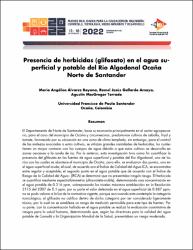
| dc.description.abstract | El Departamento de Norte de Santander, basa su economía principalmente en el sector agropecuario, para el caso del municipio de Ocaña y circunvecinos, predominan cultivos de cebolla, frijol y tomate, favorecido por su ubicación en una zona de clima templado, sin embargo, para el control de las malezas asociadas a estos cultivos, se utilizan grandes cantidades de herbicidas, los cuales tienen un mayor contacto con los cuerpos de agua debido a que estos cultivos se desarrollan en zonas cercanas a la ronda de rio. Por lo anterior, esta investigación tuvo como fin cuantificar la presencia del glifosato en las fuentes de agua superficial y potable del Rio Algodonal, uno de los ríos con los cuales se abastece el municipio de Ocaña; para ello, se evaluaron dos puntos, uno en el agua superficial cruda; el cual, de acuerdo con el Índice de Calidad del Agua-ICA, se encontraba entre regular y aceptable; el segundo punto en el agua potable que de acuerdo con el Índice de Riesgo de la Calidad del Agua - (IRCA) se determinó que no presentaba ningún riesgo. El herbicida se cuantificó mediante espectrofotometría (ultravioleta-visible), determinando una concentración en el agua potable de 0.316 ppm, sobrepasando los niveles máximos establecidos en la Resolución 2115 del 2007 de 0.1 ppm; por su parte el valor detectado en el agua superficial de 0.887 ppm, no se pudo valorar a la luz de la normativa vigente, porque aun cuando esta contempla la categoría toxicológica, el glifosato no califica dentro de dicha categoría por ser considerado ligeramente tóxico, por lo cual no se establece un rango de medición permisible para este tipo de fuentes. Por su parte, con la concentración hallada en el agua potable se realizó la evaluación cuantitativa de riesgos para la salud humana, determinando que, según las directrices para la calidad del agua potable de Canadá y la Organización Mundial de la Salud, presentaban un riesgo moderado. | en_US |
| dc.language.iso | spa | en_US |
| dc.relation | https://acofipapers.org/index.php/eiei/article/view/2333 | en_US |
| dc.title | Presencia de herbicidas (glifosato) en el agua superficial y potable del Río Algodonal Ocaña Norte de Santander | en_US |
| dcterms.references | Kwiatkowska, M., Reszka, E., Woźniak, K., Jabłońska, E., Michałowicz, J., & Bukowska, B. (2017). DNA damage and methylation induced by glyphosate in human peripheral blood mononuclear cells (in vitro study). Food and Chemical Toxicology, 105, 93–98. https://doi.org/10.1016/j.fct.2017.03.051 | |
| dcterms.references | Lemly, A. D. (1996). Evaluation of the hazard quotient method for risk assessment of selenium. Eco toxicology and Environmental Safety, 35(2), 156–162. https://doi.org/10.1006/eesa.1996.0095 | |
| dcterms.references | Mesnage, R., Defarge, N., Spiroux de Vendômois, J., & Séralini, G. E. (2015). Potential toxic effects of glyphosate and its commercial formulations below regulatory limits. Food and Chemical Toxico logy, 84, 133–153. https://doi.org/10.1016/j.fct.2015.08.012 | |
| dcterms.references | Nagaraja, P., & Bhaskara, B. L. (2006). Sensitive spectrophotometric assessment of carbofuran using dapsone as a new chromogenic reagent in formulations and environmental samples. Ecletica Qui mica, 31(4), 43–48. https://doi.org/10.1590/S0100-46702006000400006 | |
| dcterms.references | Rendón-Von Osten, J., & Dzul-Caamal, R. (2017). Glyphosate residues in groundwater, drinking water and urine of subsistence farmers from intensive agriculture localities: A survey in Hopelchén, Campeche, Mexico. International Journal of Environmental Research and Public Health, 14(6). https://doi.org/10.3390/ijerph14060595 | |
| dcterms.references | Tzaskos, D. F., Marcovicz, C., Dias, N. M. P., & Rosso, N. D. (2012). Development of sampling for quantification of glyphosate in natural waters. Ciência e Agrotecnologia, 36(4), 399–405. https://doi.org/10.1590/s1413-70542012000400003 | |
| dcterms.references | Watts, M., Clausing, P., Lyssimachou, A., Schutte, G., Guadagnini, R., & Marquez, E. (2016). Glyphosate. In Pesticide Action Network International. PAN Asia Pacific. Consultado el 15 de marzo de 2022 en https://pan-international.org/wp-content/uploads/Glyphosate-monograph.pdf | |
| dcterms.references | World Health Organization. (2017). Guidelines for Drinking water Quality (Fourth). World Health Organization. Consultado el 12 de abril de 2022 en https://apps.who.int/iris/handle/10665/254637 | |
| dcterms.references | Anderson, A.-M., Byrtus, Gary., & Humphries, Dave. (2015). Glyphosate residues in Alberta’s at mospheric deposition, soils and surface waters /. In Glyphosate residues in Alberta’s atmospheric deposition, soils and surface waters /. https://doi.org/10.5962/bhl.title.102010 | |
| dcterms.references | Cuevas, A., & Puentes, B. (2018). El manejo de las malezas en el programa AMTEC. FE DEARROZ, 1–70. Consultado el 10 de abril de 2022 en http://www.fedearroz.com.co/docs/car tilla_malezas.pdf | |
| dcterms.references | EPA. (2011). Risk Characterization. Environmental Protection Agency (USA). Consultado el 21 de julio de 2021 en http://www.epa.ohio.gov/portals/30/Brownfield_Conference/%0Adocs/Presen tations/3-Risk characterization.pdf | |
| dcterms.references | Fluegge, K., & Fluegge, K. (2016). Glyphosate use predicts healthcare utilization for ADHD in the healthcare cost and utilization project net (HCUPnet): A two-way fixed-effects analysis. Polish Journal of Environmental Studies, 25(4), 1489–1503. https://doi.org/10.15244/pjoes/61742 | |
| dcterms.references | Fortes, C., Mastroeni, S., Segatto, M., Hohmann, C., Miligi, L., Bakos, L., & Bonamigo, R. (2016). Occupational Exposure to Pesticides with Occupational Sun Exposure Increases the Risk for Cuta neous Melanoma. Journal of Occupational and Environmental Medicine, 58(4), 370–375. https://doi.org/10.1097/JOM.0000000000000665 | |
| dcterms.references | Gobernación de Norte de Santander. (2020). Plan Departamental de Extensión Agropecuaria Norte de Santander. Consultado el 12 de abril de 2022 en https://repository.agrosa via.co/handle/20.500.12324/36541 | |
| dcterms.references | Health Canada (HC). (2006). Guidelines for Canadian drinking water quality: Guideline Technical Document Glyphosate. Water Quality and Health Bureau, Healthy Environments and Consumer Sa fety Branch, 1–5. Consultado el 10 de marzo de 2021 en https://www.canada.ca/en/health-ca nada/services/publications/healthy-living/guidelines-canadian-drinking-water-quality-guideline-technical-document-glyphosate.html#fn30 | |
| dcterms.references | Jayasumana, C., Gunatilake, S., & Senanayake, P. (2014). Glyphosate, hard water and nephrotoxic metals: ¿Are they the culprits behind the epidemic of chronic kidney disease of unknown etiology in Sri Lanka? International Journal of Environmental Research and Public Health, 11(2), 2125–2147. https://doi.org/10.3390/ijerph110202125 | |
| dc.title.translated | Presence of herbicides (glyphosate) in surface water and drinking water from the Algodonal Ocaña River in Norte de Santander | en_US |
| dc.contributor.cvlac | María Angélica Álvarez Bayona [0000156889] | en_US |
| dc.contributor.cvlac | Romel Jesús Gallardo Amaya [0000883590] | en_US |
| dc.contributor.cvlac | Agustín Armando Macgregor [0001455829] | en_US |
| dc.contributor.googlescholar | María Angelica Álvarez Bayona [WICQdWQAAAAJ] | en_US |
| dc.contributor.googlescholar | Romel Jesús Gallardo Amaya [kCbpxb4AAAAJ] | en_US |
| dc.contributor.googlescholar | Agustín Armando Macgregor [2KSfI3EAAAAJ] | en_US |
| dc.contributor.orcid | María Angelica Álvarez Bayona [0000-0002-9464-9884] | en_US |
| dc.contributor.orcid | Romel Jesús Gallardo Amaya [0000-0002-4740-4841] | en_US |
| dc.contributor.orcid | Agustín Armando Macgregor [0000-0002-5144-8572] | en_US |
| dc.contributor.researchgate | María Angelica Álvarez Bayona [Maria-Angelica-Alvarez-Bayona] | en_US |
| dc.contributor.researchgate | Agustín Armando Macgregor [Agustin-Macgregor-Torrado] | en_US |
| dc.description.abstractenglish | The Department of Norte de Santander, bases its economy mainly on the agricultural sector, in the case of the municipality of Ocaña and surrounding areas, onion, bean and tomato crops predominate, favored by its location in a temperate climate zone, however, for the control of weeds asso ciated with these crops, large amounts of herbicides are used, which have greater contact with water bodies because these crops are developed in areas close to the river banks. Therefore, the purpose of this research was to quantify the presence of glyphosate in the surface and drinking water sources of the Algodonal River, one of the rivers that supplies the municipality of Ocaña; for this purpose, two points were evaluated, one in the raw surface water, which, according to the Water Quality Index (ICA), was between regular and acceptable; the second point in the drinking water, which according to the Water Quality Risk Index (IRCA) was determined not to present any risk. The herbicide was quantified by spectrophotometry (ultraviolet-visible), determining a concentration in drinking water of 0.316 ppm, exceeding the maximum levels established in Resolution 2115 of 2007 of 0.1 ppm; for its part the value detected in surface water of 0.887 ppm, could not be detected. 887 ppm, could not be assessed in light of current regulations, because even though it contemplates the toxicological category, glyphosate does not qualify within that category because it is considered slightly toxic, so it does not establish an allowable measurement range for this type of source. The concentration found in the drinking water was used to perform a quantitative risk assessment for human health, which determined that, according to the Canadian and World HealthOrganization guidelines for drinking water quality, it presented a moderate risk. | en_US |
| dc.subject.proposal | contaminación | en_US |
| dc.subject.proposal | glisofato | en_US |
| dc.subject.proposal | regulations | en_US |
| dc.subject.keywords | contaminants | en_US |
| dc.subject.keywords | glyphosate | en_US |
| dc.subject.keywords | regulación | en_US |
| dc.publisher.faculty | Facultad ingenierías | en_US |
| dc.type.redcol | http://purl.org/redcol/resource_type/ART | en_US |
| dc.identifier.DOI | https://doi.org/10.26507/paper.2333 | en_US |
Ficheros en el ítem
Este ítem aparece en la(s) siguiente(s) colección(ones)
-
Artículos [43]

