

Mostrar el registro sencillo del ítem
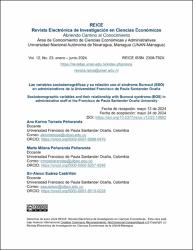
Las variables sociodemográficas y su relación con el síndrome Burnout (SBO) en administrativos de la Universidad Francisco de Paula Santander Ocaña
| dc.contributor.author | Peñaranda Peñaranda, Marta Milena | |
| dc.contributor.author | Suárez Castrillón, Sir-Alexci | |
| dc.contributor.author | Torrado Peñaranda, Ana Karina | |
| dc.coverage.spatial | Colombia | en_US |
| dc.date.accessioned | 2025-03-28T20:48:40Z | |
| dc.date.available | 2025-03-28T20:48:40Z | |
| dc.date.issued | 2024 | |
| dc.identifier.issn | 2308782X | en_US |
| dc.identifier.uri | https://repositorioinstitucional.ufpso.edu.co/xmlui/handle/20.500.14167/5042 | |
| dc.description.abstract | Las pretensiones de la investigación van encaminadas a determinar la relación entre las variables sociodemográficas y el síndrome Burnout en el personal administrativo de la Universidad Francisco de Paula Santander Ocaña, la cual precisó de una metodología de investigación con enfoque cuantitativo de tipo transversal descriptivo, realizado a una población finita de administrativos contemplando datos sociodemográficos como sexo, condición laboral, edad y estado civil, seguido de la aplicación de la escala Maslach Burnout Inventory constituido por 16 ítems que abordan las dimensiones de agotamiento, cinismo y eficacia. Los hallazgos revelaron que una pequeña población de hombres y mujeres sin muchas diferencias marcadas comienza a padecer el síndrome burnout, así mismo el tipo de contratación nombrado y contratado alertan igualmente la presencia del síndrome. En relación con la edad se apreciaronligeras diferencias al identificar que sin importar la edad el personal se encuentra con toda la energía para seguir realizando su trabajo, mientras que en la dimensión cinismo se presentan niveles medios y altos en la pérdida de motivación hacia el trabajo, haciéndose más visible esta pérdida cuando han superado la edad de 45 años y su eficacia este grupo solo alcanzaniveles bajos y medios. Para la variable sociodemográficade estado civil el grupo con mayor riesgo ante el síndrome burnout es el estado civil casados. La presencia de este riesgo demanda el interés de la institución. | en_US |
| dc.language.iso | spa | en_US |
| dc.relation | https://camjol.info/index.php/REICE/article/view/18802/22798 | en_US |
| dc.title | Las variables sociodemográficas y su relación con el síndrome Burnout (SBO) en administrativos de la Universidad Francisco de Paula Santander Ocaña | en_US |
| dc.title.translated | Sociodemographic variables and their relationship with Burnout syndrome (BOS) in administrative staff at the Francisco de Paula Santander Ocaña University | en_US |
| dc.contributor.cvlac | [0001353858] | en_US |
| dc.contributor.cvlac | [0001400419] | en_US |
| dc.contributor.cvlac | [0002195458] | en_US |
| dc.contributor.googlescholar | [yflam14AAAAJ] | en_US |
| dc.contributor.orcid | [0000-0002-9257-9245] | en_US |
| dc.contributor.orcid | [0000-0001-8010-0228] | en_US |
| dc.contributor.orcid | [0009-0007-6898-0470] | en_US |
| dc.contributor.researchgate | [Marta-Penaranda] | en_US |
| dc.contributor.researchgate | [Sir-Alexci-Suarez-Castrillon-2292398529] | en_US |
| dc.contributor.researchgate | [Ana-Karina-Torrado-Penaranda-2304192693] | en_US |
| dc.contributor.scopus | [58106706700] | en_US |
| dc.contributor.scopus | [47661532900] | en_US |
| dc.description.abstractenglish | The aims of the research are aimed at determining the relationship between sociodemographic variables and Burnout syndrome in the administrative staff of the Francisco de Paula Santander Ocaña University, which required a research methodology with a descriptive cross-sectional quantitative approach, carried out through a finite population of administrators considering sociodemographic data such as sex, employment status, age and marital status, followed by the application of the Maslach Burnout Inventory scale consisting of 16 items that address the dimensions of exhaustion, cynicism and effectiveness. The findings revealed that a small population of men and women without many marked differences begin to suffer from burnout syndrome, likewise the type of hiring appointed and hired also alerts the presence of the syndrome. In relation to age, slight differences were observed when identifying that regardless of age, the staff has all the energy to continue doing their work, while in the cynicism dimension thereare medium and high levels of loss of motivation towards work. , this loss becoming more visible when they have surpassed the age of 45 and their effectiveness in this group only reaches low and medium levels. For the sociodemographic variables of maritalstatus, the group with the highest risk of burnout syndrome is the married marital status. The presence of this risk demands the interest of the institution | en_US |
| dc.subject.proposal | Administrativos | en_US |
| dc.subject.proposal | Síndrome Burnout | en_US |
| dc.subject.proposal | Variables sociodemográficas | en_US |
| dc.subject.keywords | Administrative | en_US |
| dc.subject.keywords | Burnout syndrome | en_US |
| dc.subject.keywords | Sociodemographic variables | en_US |
| dc.subject.lemb | Síndrome burnout | en_US |
| dc.subject.lemb | Variables sociodemográficas | en_US |
| dc.publisher.faculty | Facultad ciencias administrativas y económicas | en_US |
| dc.type.redcol | http://purl.org/redcol/resource_type/ART | en_US |
| dc.relation.references | Acosta, H. (2009). Burnout y su relación con variables sociodemográficas, sociolaborales y organizacionales en profesores universitarios chilenos. Fòrum de Recerca, 14, 1–22. https://dialnet.unirioja.es/servlet/articulo?codigo=4806988 | en_US |
| dc.relation.references | Almeida, M., Nazaré, E., Guimarães, F., Evangelista, R., Gómez, A., & Vieira, B. (2015). Síndrome de burnout: un estudio con profesores. Salud de Los Trabajadores, 23(1), 19–27. https://dialnet.unirioja.es/servlet/articulo?codigo=6335995&info=resumen&idioma=SPA | en_US |
| dc.relation.references | Apiquian, A. (2007). El Síndrome Del Burnout En Las Empresas. https://es.scribd.com/document/325897218/El-Sindrome-de-Burn-Out-en-Las-Empresas | en_US |
| dc.relation.references | Atalaya Pisco, M. C. (2018). Satisfacción laboral y síndrome Burnout en trabajadores administrativos de una universidad estatal. Universidad Nacional Mayor de San Marcos. https://cybertesis.unmsm.edu.pe/item/5bccb4bf-f019-4e40-ab86-5f3b585f43a7 | en_US |
| dc.relation.references | Benevides Pereira, A. M., & Moreno Jiménez, B. (2002). O burnout em un grupo de psicólogos brasileiros. Burnout: Quando o Trabalho Ameaça o Bem-Estar Do Trabalhador, 157–186. https://dialnet.unirioja.es/servlet/articulo?codigo=5000912 | en_US |
| dc.relation.references | Burke, R. J., & Deszca, E. (1986). Correlates of Psychological Burnout Phases among Police Officers. Human Relations, 39(6), 487–501. https://doi.org/10.1177/001872678603900601 | en_US |
| dc.relation.references | Cano-Garcia, F. J., Padilla-Muñoz, E. M., & Carrasco-Ortiz, M. Á. (2005). Personality and contextual variables in teacher burnout. Personality and Individual Differences, 38(4), 929–940. https://doi.org/10.1016/J.PAID.2004.06.018 | en_US |
| dc.relation.references | Caprara, G. V., Barbaranelli, C., Borgogni, L., & Bermúdez Moreno, J. (2001). BFQ: cuestionario “Big Five” : manual. TEA Ediciones. https://dialnet.unirioja.es/servlet/libro?codigo=894854 | en_US |
| dc.relation.references | Cárdenas, M., Méndez, L., & González, M. (2014). Desempeño, estrés, burnout y variables personales de los docentes universitarios. Educere, 18(60), 289–302. | en_US |
| dc.relation.references | Cherniss, C. (1980). Professional burnout in human service organizations. Praeger. | en_US |
| dc.relation.references | Daley, M. R. (1979). Preventing Worker Burnout in Child Welfare. Child Welfare, 58(7), 443–450. | en_US |
| dc.relation.references | Deary, I. J., Blenkin, H., Agius, R. M., Endler, N. S., Zealley, H., & Wood, R. (1996). Models of job-related stress and personal achievement among consultant doctors. British Journal of Psychology, 87, 3–29. https://doi.org/10.1111/j.2044-8295.1996.tb02574.x | en_US |
| dc.relation.references | Eastburg, M. C., Williamson, M., Gorsuch, R., & Ridley, C. (1994). Social Support, Personality, and Burnout in Nurses. Journal of Applied Social Psychology, 24(14), 1233–1250. https://doi.org/10.1111/J.1559-1816.1994.TB00556.X | en_US |
| dc.relation.references | Freudenberger, H. J. (1974). Staff Burn‐Out. Journal of Social Issues, 30(1), 159–165. https://doi.org/10.1111/J.1540-4560.1974.TB00706.X | en_US |
| dc.relation.references | García García, J. M., & Herrero Remuzgo, S. (2008). Variables sociodemográficas y síndrome de burnout en una muestra multiocupacional del Hospital Psiquiátrico Penitenciario de Sevilla. Apuntes de Psicología, 26(3), 459–477. https://dialnet.unirioja.es/servlet/articulo?codigo=2995386 | en_US |
| dc.relation.references | Gil-Monte, P. R., & Peiró, J. M. (1997). Desgaste psíquico en el trabajo: el síndrome de quemarse. Desgaste Psíquico En El Trabajo: El Síndrome de Quemarse. https://www.sintesis.com/libro/desgaste-psiquico-en-el-trabajo-el-sindrome-de-quemarse | en_US |
| dc.relation.references | Hernández-Martín, L., Fernández-Calvo, B., Ramos, F., & Contador, I. (2006). El síndrome de burnout en funcionarios de vigilancia de un centro penitenciario. International Journal of Clinical and Health Psychology, 6(3), 599–611. https://www.redalyc.org/articulo.oa?id=33760306 | en_US |
| dc.relation.references | Langelaan, S., Bakker, A. B., van Doornen, L. J. P., & Schaufeli, W. B. (2006). Burnout and work engagement: Do individual differences make a difference? Personality and Individual Differences, 40(3), 521–532. https://doi.org/10.1016/J.PAID.2005.07.009 | en_US |
| dc.relation.references | Madero Llanes, J. E., Ulibarri Benítez, H. A., Andrés Miguel, P. C., Paredes Cetina, F. E., & Briceño Gómez, M. A. (2013). BURNOUT EN PERSONAL ADMINISTRATIVO DE UNA INSTITUCIÓN DE EDUCACIÓN SUPERIOR TECNOLÓGICA DE YUCATÁN, MÉXICO. Revista Electrónica de Psicología Iztacala, 16(3). https://www.revistas.unam.mx/index.php/repi/article/view/41788 | en_US |
| dc.relation.references | Medina, G. (2004). El síndrome de Burnout en ejecutivos de recursos humanos. Researchgate. https://www.researchgate.net/publication/37612989_El_sindrome_de_Burnout_en_ejecutivos_de_recursos_humanos | en_US |
| dc.relation.references | Pines, A., & Kafry, D. (1978). Occupational tedium in the social services. Social Work, 23(6), 499–507. https://pubmed.ncbi.nlm.nih.gov/10314457/ | en_US |
| dc.relation.references | Ramírez Pérez, M., & Zurita Zurita, R. (2010). Variables organizacionales y psicosociales asociadas al síndrome de burnout en trabajadores del ámbito educacional. Polis, 9(25), 515–534. https://doi.org/10.4067/S0718-65682010000100029 | en_US |
| dc.relation.references | Restrepo Torres, L. D. (2020). Identificación de los Factores Psicológicos del Síndrome de Burnout Bajo el Modelo de Maslach y Jackson en Docentes y Personal Administrativo de la Universidad de los Llanos, Sede San Antonio en la Ciudad de Villavicencio- Meta en el Año 2019. Universidad de Los Llanos.. Disponible En: Https://Repositorio.Unillanos.Edu.Co/Handle/001/1546. https://repositorio.unillanos.edu.co/handle/001/1546 | en_US |
| dc.relation.references | ROBLES, J. M. (2017). PROCESO DE IDENTIFICACIÓN DE LOS RIESGOS PSICOSOCIALES PRESENTES EN LA ACTIVIDAD LABORAL DE LOS TRABAJADORES DE NAVEFAR S.A. Universidad de Guayaquil Facultad de Ciencias Psicológicas. http://repositorio.ug.edu.ec/handle/redug/25758 | en_US |
| dc.relation.references | Rodríguez Villanueva, M. N., & Huapaya Flores, G. A. (2021). Carga laboral y el Síndrome Burnout en el personal administrativo y docente universitario. Revista Ecuatoriana de Psicología, 4(8), 5–17. https://doi.org/10.33996/REPSI.V4I8.47 | en_US |
| dc.relation.references | Sandrín, L. (2005). Ayudar sin quemarse. San pablo comunicacion SSP. | en_US |
| dc.relation.references | Wilson, D., & Chiwakata, L. (1989). Locus of control and burnout among nurses in Zimbabwe. Psychological Reports, 65(2), 426. https://doi.org/10.2466/PR0.1989.65.2.426 | en_US |
| dc.relation.references | Zellars, K. L., & Perrewé, P. L. (2001). Affective personality and the content of emotional social support: Coping in organizations. Journal of Applied Psychology, 86(3), 459–467. https://doi.org/10.1037/0021-9010.86.3.459 | en_US |
| dc.relation.references | Zellars, K. L., Perrewé, P. L., & Hochwarter, W. A. (2000). Burnout in health care: The role of the five factors of personality. Journal of Applied Social Psychology, 30(8), 1570–1598. https://doi.org/10.1111/J.1559-1816.2000.TB02456.X | en_US |
| dc.identifier.DOI | 10.5377/reice.v12i23.18802 | en_US |
Ficheros en el ítem
Este ítem aparece en la(s) siguiente(s) colección(ones)
-
Artículos [42]

